(+373) 68 60 11 85
Suncity Shopping Center, 1st floor, boutique 1109
(+373) 68 60 11 86
Atrium Shopping Center, 3rd floor, boutique 3012
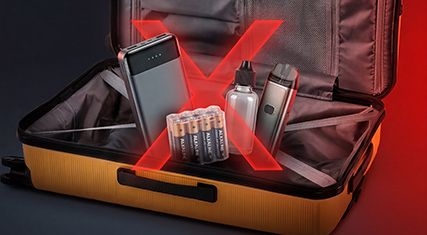
What You Should Not Pack in a Suitcase Before a Flight:Full List and Common Mistakes
Before a flight, many people pack their luggage on autopilot:clothes, cosmetics, chargers, small electronics —everything quickly goes into the suitcase. That is exactly why airport problems happen so often. Some items must never be placed in checked baggage, others can only be carried in hand luggage, and some are allowed but with restrictions. If you understand these rules in advance, you can avoid extra questions at security, delays before boarding, and situations where you have to urgently repack right at the airport.
1) Power bank
A power bank must not be placed in checked baggage. It should only be carried in hand luggage. The reason is simple:portable chargers contain lithium batteries, and if such a battery overheats or gets damaged, the crew can notice the problem much faster and respond if it is in the cabin. Official rules state that portable chargers, spare lithium batteries, electronic cigarettes, and vaping devices are not allowed in checked baggage and must remain with the passenger in cabin baggage.
2) Spare lithium batteries and battery packs
Spare batteries, camera batteries, removable battery modules, and other spare lithium batteries should not simply be thrown into a suitcase and checked in. They must be carried with you, and the contacts should be protected against short circuit:leave them in the original packaging, cover the terminals, or place them in a separate pouch or case. There are also capacity limits:batteries up to 100 Wh are generally allowed, batteries from 101 to 160 Wh usually require airline approval, and batteries above 160 Wh are prohibited on passenger flights.
3) Electronic cigarettes and vapes
Electronic cigarettes, vapes, and other personal vaporizing devices must not go into checked baggage. They must be carried in hand luggage, not in checked luggage. In addition, such devices must be protected from accidental activation. This is an important detail:even if the device is small, it still falls into a category with separate transport rules.
4) Liquids, gels, creams, and aerosols over 100 ml
One of the most common mistakes is confusing checked baggage with hand luggage. For the cabin, the liquids rule applies:each container must not exceed 100 ml, and all of them are usually carried together in one transparent bag of about one liter. This applies not only to water or shampoo, but also to creams, gels, pastes, aerosols, and many cosmetic products. If a bottle or container is larger than 100 ml, it may be taken away at security even if there is only a small amount left inside. In checked baggage, such liquids are usually allowed without this size limit.
5) Certain liquid or gel-like food items
Many people think the rule only applies to cosmetics, but some food items also fall under the liquids and gels category. If a food product is considered a liquid or gel by consistency and exceeds 100 ml, it is generally not allowed in hand luggage. So this is not only about bottles and jars, but also about what kind of food you take with you into the cabin.
6) Smart luggage with a built-in battery
If your suitcase has a built-in battery, GPS module, power bank, or another lithium battery inside, this type of luggage must be checked separately before the flight. In many cases, such luggage may only be transported as carry-on, and the battery may need to be removed and carried separately in the cabin. This is not the most common situation, but if you have this type of suitcase, the rule matters.
7) Large batteries and high-capacity battery packs
For most passengers, ordinary batteries for phones, cameras, laptops, or power banks fall within standard limits. But if you are dealing with higher-capacity batteries, additional rules apply. Batteries above 100 Wh and up to 160 Wh can usually only be carried with airline approval and in limited quantities. That is why, if you travel with unusual equipment, it is better to check the specifications in advance instead of relying only on general experience.
The most common mistakes usually look like this:a power bank is placed in a suitcase “just in case,”spare batteries are forgotten in a luggage pocket, liquids over 100 ml are left in hand luggage, and a vape is packed together with the rest of the electronics. The problem is that many people remember the rules only at security. There is also one important detail:if your carry-on bag is taken from you at the gate and placed into checked baggage, spare lithium batteries must be removed and kept with you in the cabin.
There is no single universal scenario here:a lot depends on the airport, the airline, the stage of security control, and the type of item. Sometimes you may be allowed to move the item from checked baggage into hand luggage, sometimes you can hand it over to someone accompanying you, and sometimes you will have to leave it behind. That is why the best strategy is not “I’ll sort it out there,”but checking your luggage in advance. This is especially important for power banks, spare batteries, vapes, and liquids in hand luggage.
Before you close your suitcase, go through this list:
power bank —hand luggage only;
spare batteries and battery packs —carry them with you, not in checked baggage;protect the contacts if possible;
vape and electronic cigarette —hand luggage only;
liquids in hand luggage —maximum 100 ml per container;
smart suitcase with built-in battery —check the separate rules;
non-standard or high-capacity batteries —verify your airline’s rules.